1000 Nights of Pokémon Sleep: The Good and the Bad

This is a personal retrospective on Pokémon Sleep after 1000 nights, including how the app evolved since launch and why I still use it today.
There are not many apps I’ve opened every single day for years.
Not social media. Not productivity tools. Definitely not Duolingo.
People love flexing their 1000-day language streaks like they climbed Everest with a green owl strapped to their back. Meanwhile, my longest Duolingo streak barely survived three months before collapsing somewhere between “repeat this sentence about apples” and “please upgrade to Super.” I think it lasted around 100 days. Maybe seven years ago.
But this week, I hit a different kind of milestone: 1000 nights in Pokémon Sleep.
Which is honestly absurd.
Not because the app is bad.
Because it’s weirdly inconvenient.

The Sleep Tracking App That Wanted to Live in Your Bed
From the very beginning, Pokémon Sleep felt like an experiment designed by someone who had never actually slept next to a phone before. For a surprisingly long time, there was no proper support for smartwatches or fitness bands. If you wanted to track your sleep, you had to physically place your phone on the mattress, next to your pillow.
The screen itself turns off and you place the phone face down, but the app still has to stay actively open the entire night to track your sleep properly. Which means your phone isn’t really off. If you pick it up or move it incorrectly, the display lights back up with the app’s very blue interface reminding you that yes, there is still a tiny Pokémon laboratory running beside your head at 2 AM.
The app eventually expanded support and now allows syncing through platforms like Apple Health, Fitbit, Samsung Health, and Garmin Connect. But since I don’t own any of those ecosystems, I am still living the classic Pokémon Sleep experience:
Phone. Next to pillow. Every night.
And honestly? That’s still one of the biggest problems.
The app drains battery like a small portable heater. My phone has to stay plugged in the entire night, uncovered so it doesn’t overheat itself into another dimension. It also means the entire ritual of “going to sleep” includes setting up Pokémon Sleep correctly like I’m preparing laboratory equipment.
Which sounds ridiculous.
Because it is.
Technically, It’s Not Even 1000 Consecutive Nights

There is an asterisk attached to my achievement.
During a holiday in Tunisia, the hotel Wi‑Fi was so weak that the app basically gave up on existence.
Pokémon Sleep needs internet access to function properly, and our room only caught a faint, dying signal drifting from the reception area downstairs. So for part of the trip, my research career as a professional Snorlax sleep observer came to an abrupt halt.
Which means this is not a perfect 1000-night streak.
And somehow I like that better.
Perfect streak culture already exists everywhere else on the internet. Productivity apps turn consistency into a moral achievement. Miss one day and suddenly you feel like you personally disappointed a cartoon mascot.
Pokémon Sleep feels different.
Maybe because the entire premise is fundamentally unserious.
You Don’t Save the World. You Just Feed Snorlax.
The core gameplay loop of Pokémon Sleep is gloriously low stakes.
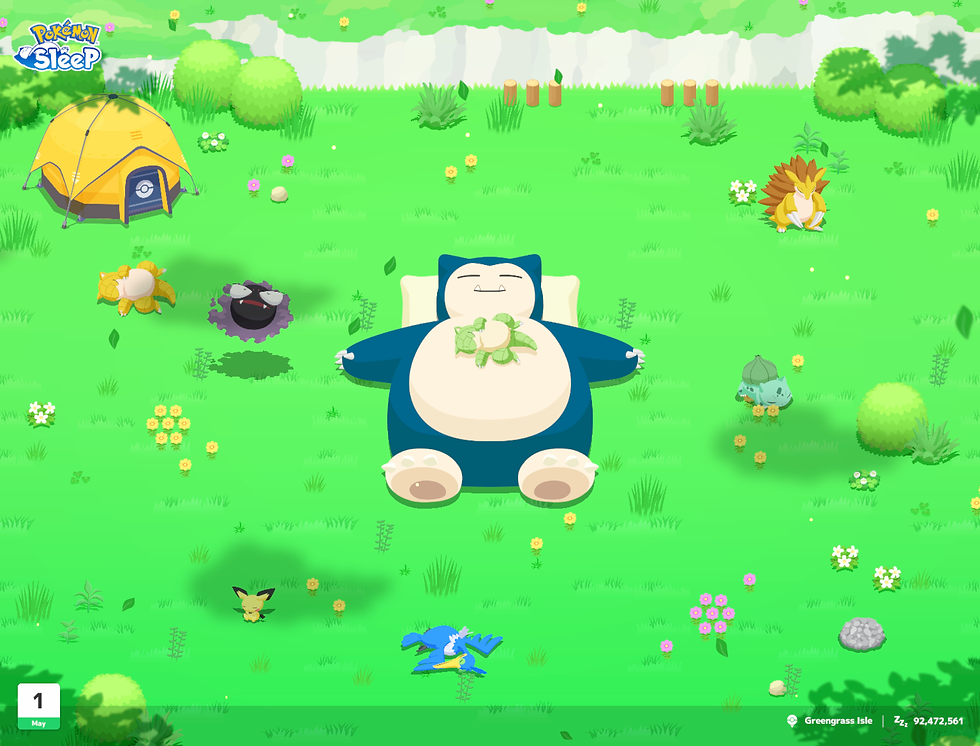
Every Monday, you arrive at a new campsite and meet a Snorlax. This Snorlax has opinions. Specifically about food.
Some weeks it wants curries. Some weeks salads. Some weeks desserts. It also prefers specific berry types, so you build a team of five helper Pokémon around its preferences. Those helper Pokémon gather berries and ingredients throughout the day.
You feed Snorlax. You cook three meals a day. You slowly raise its strength level.
Stronger Snorlax means rarer Pokémon will appear during the night. Then comes the morning routine.
You wake up, open the app, and discover a small pile of sleeping Pokémon sprawled around the campsite in various levels of exhaustion. You study their sleep styles, feed them biscuits, recruit new helpers, and slowly expand your Pokédex.
That’s it.
No battles. No competitive ranking. No urgent daily grind.
Just sleepy creatures taking naps near an increasingly overfed Snorlax.
And somehow, that loop works.
The Monday Morning Problem
Pokémon Sleep is probably the slowest game I willingly play. Everything takes time.
The app boots slowly. The sleep results take forever to process. Menus have the energy of a tired receptionist searching for paperwork.
And Monday mornings are especially dangerous. Because Monday is reset day.
You wrap up the previous week, collect rewards, say goodbye to one campsite, travel to another area, evaluate Snorlax’s food preferences, reorganize your helper team, rethink ingredient production, and prepare the entire upcoming week.
All before coffee.
There are mornings where Pokémon Sleep feels less like a cozy sleep tracker and more like project management for a wildlife research department.
Still Growing Instead of Falling Asleep

The surprising thing about Pokémon Sleep is not that it survived.
It’s that nearly three years after launch — the app released on July 17, 2023 — it still feels like it’s actively growing instead of slowly drifting into maintenance mode. That’s unusually rare for mobile games. Especially for novelty apps built around a single gimmick.
But Pokémon Sleep kept evolving. New Pokémon continue to appear. New areas get added. There are seasonal events, themed weeks, and smaller monthly celebrations tied to the full moon called Good Sleep Days.
That ongoing support matters more than I expected.
A lot of mobile games eventually become ghost towns wearing event banners. Pokémon Sleep still feels maintained. Still active. Still slightly strange.
And maybe that’s why I kept coming back.
A Very Different Kind of Habit
I think the reason Pokémon Sleep survived in my routine while apps like Duolingo didn’t is simple:
It asks for consistency without pretending consistency makes you morally superior.
There’s no passive-aggressive owl. No shame spiral. No productivity cosplay.
You sleep. You feed a giant creature. Tiny monsters bring berries. Catching a Shiny Pokémon still feels just as exciting. Life continues.
And after 1000 nights, that weird little ritual became part of my evenings in a way very few games ever have. Not because it’s perfect. Not because it’s efficient. Not even because it’s particularly well designed.
But because somehow, against all odds, Pokémon Sleep managed to turn bedtime into a game I actually wanted to keep playing.
Which might be the most impressive thing any mobile app has accomplished in years.
Topics: Pokémon, Review, Cozy mobile games, Pokémon Sleep long-term review, daily routine


Comments