Learning to Die in Style: My Soulslike Experience

As the year winds down, I’ve been thinking about what it brought—the new things, the unexpected things, the things that left a mark. And strangely enough, for me, that thing was Soulslike games.
I never liked them. For most of my life, they felt like the gaming equivalent of self-punishment. You die a lot. You repeat. You’re supposed to react quickly and precisely—not exactly an ADHD superpower. I never understood why anyone would choose to play something that kills them on purpose. I want to enjoy the game, not survive it. Sure, there should be some challenge, but not the kind that sends me back to the same checkpoint twenty times in a row. Dying repeatedly isn’t satisfying — it’s exhausting. Maybe I wasn’t just uninterested. Maybe I was actually scared of even trying.
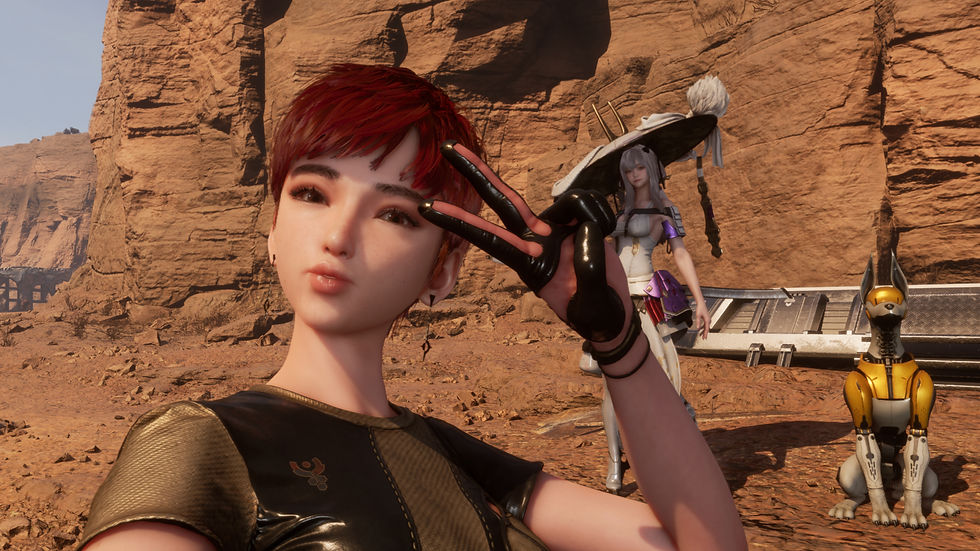
But this year, something changed. I picked up Stellar Blade—and halfway through, I realized I was playing a Soulslike (or s Souls-lite?).
Then came Flintlock. I loved it… right up until the first boss fight.
Rammuha.

What Even Is a Soulslike?
The term Soulslike comes from Demon’s Souls and Dark Souls—games designed by Hidetaka Miyazaki that basically said:
“Oh, you think you’re good at games? Prove it.”
Soulslike games are built on high difficulty, precise combat, and learning through failure. You don’t just play — you study the game.
You die, you respawn, you adjust.
You repeat until you finally land that perfect dodge or strike.
Their worlds are often dark, mysterious, and deliberately vague. They rarely tell you what to do—they show it through the environment, leaving room for interpretation. That makes every victory (and every tiny discovery) feel like you earned it.
Soulslike vs. Souls-lite (a.k.a. Pain vs. Mild Discomfort)
Soulslike games are the full “prepare to suffer” package—tight dodges, punishing timing, cryptic worlds, and bosses designed to test your will to live. Souls-lite games borrow the same vibe but dial down the misery: gentler difficulty, more checkpoints, clearer quests, and a story that actually wants you to follow it instead of piecing it together from ominous item descriptions.
Both Stellar Blade and Flintlock fall into this souls-lite category thanks to their Story Mode options—they let you enjoy the drama, the world, and the combat without demanding that you ascend into a kung-fu deity of perfect reaction times. Well… at least until a certain someone called Rammuha shows up.

Why Players Love Pain—The Psychology Behind It
1. The Challenge Feels Meaningful
Research on game motivation shows that failure isn’t demotivating when it feels fair or learnable.
Each death becomes feedback. “Okay, this attack was too slow—next time I’ll roll left.”
That sense of growth—even through suffering—hits deep.
It’s the same dopamine rush as learning an instrument or solving a puzzle.
Except here, the puzzle tries to kill you.
2. The Mastery Loop
Soulslike games reward mastery, not grinding.
When you win, it’s not because you bought better gear—it’s because you got better.
That’s pure psychological gold. Humans love measurable progress.
Even the smallest improvement—dodging one attack pattern you couldn’t before—feels euphoric.
3. Immersion and Mystery
Soulslike worlds don’t hold your hand.
They whisper instead of shout.
That sense of mystery—piecing together lore through item descriptions, ruins, and eerie silence—activates the same curiosity that fuels exploration and discovery in our brains.
It’s not just combat. It’s archeology.
4. Community and Shared Struggle
No Soulslike player suffers alone.
Online, people share strategies, guides, and memes about dying fifty times to the same boss.
That creates a sense of belonging, a shared hardship that turns frustration into pride.
It’s like running a marathon, except everyone’s wearing medieval armor and swearing at skeletons.

Why It’s Still Hard for Me (and Probably for Many ADHD Players)
Here’s the thing:
I’ve never been great at fast, precise reactions—and I don’t have the patience for dying twenty times in a row. My ADHD brain thrives on novelty, not repetition.
Soulslike games demand focus, rhythm, and restraint—basically everything I struggle with.
And yet… there’s something weirdly magnetic about them.
Maybe it’s the clarity—every mistake has a reason. Every small success feels like progress.
Or maybe it’s the atmosphere: immersive, eerie, and beautifully lonely.
Still, when I met Rammuha, my journey ended. I farmed XP, learned new abilities, tried different weapons… and still, she crushed me like a bug.
I can’t say I’m proud—but I’m not done thinking about it, either.
The (Un)Final Battle
So here I am, parked in front of Rammuha’s palace, and the You Died screen has basically become my personal end credits. And it makes me wonder: I paid full price for this world, this story, this spectacle… but how much of it will I realistically ever get to see when the difficulty spikes like this?
It’s a strange feeling—knowing the rest of the game is right there, beautifully built and fully paid for, yet locked behind a skill wall I just can’t break through.
Maybe that’s the Soulslike experience at its most honest. Or maybe it really is just another flavor of punishment. Either way, Rammuha remains undefeated—and so does my frustration.



Comments