Not Everyone Wants to Win the Race

On Skool, Rank 9, and why I play a different game
I genuinely like Skool. Enough to join around ten communities in the last month, which is either a sign of curiosity or a complete lack of impulse control. Possibly both.
Skool calls itself a community platform, but anyone who has spent more than a few days there knows that it’s also very deliberately a game. Levels, ranks, likes, engagement mechanics—all the familiar systems are in place. You participate, you comment, you get feedback, you level up. And usually, that works.

The Rank 9 Course
In one of the communities, a creator announced a special, unique course. Access would be granted to the first two people who reached Rank 9—the highest rank in the community.
My first reaction wasn’t excitement. It was curiosity. Not the offended kind. More the quiet, analytical kind that asks: Why two? What kind of behavior does this reward? And who does it quietly exclude?
Because reaching Rank 9 isn’t accidental. It requires a very specific type of participation: being almost constantly present, commenting often, encouraging others, and staying visible.
What I don’t like is spending hours liking every comment, replying “Great point!” to strangers named Bob, and carefully farming engagement just to climb a leaderboard. Not because it’s bad. And definitely not because it’s wrong. But because it’s not how I play. It’s one valid way of playing the game—just not mine.
I Am an Explorer
Last summer, during a Game Production course, I learned about Bartle taxonomy of player types. The short version is that players don’t all want the same thing from a game. The long version is this:
Bartle’s Player Types (The Actual Version)
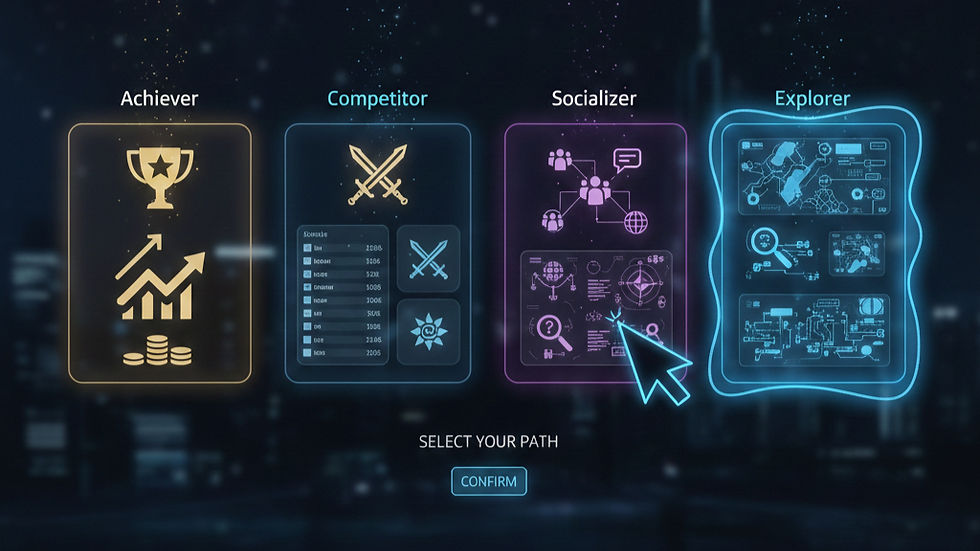
In Bartle’s taxonomy, players are usually described through four dominant motivations. Most people are a mix of them, but one or two tend to shape how they interact with a system the most.
Achievers are driven by progress and measurable success. They want to complete goals, unlock levels, optimize strategies, and see numbers go up. Ranks, badges, and clear milestones are powerful motivators for them, because these systems translate effort directly into visible achievement.
Killers (often reframed today as Competitors) are motivated by comparison and dominance. Their satisfaction comes not just from winning, but from winning against others. Leaderboards, races, and limited rewards amplify this motivation by turning progress into a zero-sum game.
Socializers play for connection. They care less about ranks and more about relationships, conversation, and shared experience. For them, the system is primarily a space to talk, support, and be seen by others, not a ladder to climb.
Explorers are motivated by curiosity. They want to understand how things work, discover hidden structures, test boundaries, and make sense of systems. Progress for an Explorer isn’t measured in speed or position, but in insight. The reward is clarity, not victory.
I am an Explorer.
Leaderboards don’t light a fire under me—they usually make me quietly step away.
And that’s not a flaw. It’s just a different way of playing.
Why Races Make Me Opt Out
I’ve never been first in this kind of competition. Not once. And over time, that creates a very specific internal response. Not “try harder,” but “don’t enter at all.” Because after enough losses, the brain learns to protect itself.
So when I see a race framed as only the first two matter, my reaction isn’t motivation. It’s instant disengagement. I don’t feel challenged. I feel filtered out.
What struck me later was how similar this felt to something completely outside gaming. Around Christmas and New Year, I attended Sigrun’s masterclasses. They were intense, generous, structured, sometimes chaotic, and overall genuinely valuable. But what stayed with me most wasn’t a specific strategy—it was the realization that different people move through systems at very different speeds and with very different motivations.
I didn’t articulate this to the Skool creator at the time, but the parallel clicked for me afterwards. The way we design challenges, rewards, and visibility often assumes one “ideal” participant. One tempo. One correct path.
And yet, real people rarely work like that.
This is something I want to explore more deeply in a future post—especially through the lens of buyer behavior and motivation.

The Unexpected Reply
I decided to write to the creator of the Rank 9 course. Not to argue, and not to complain, but to share how this particular mechanic landed for me. I acknowledged that this kind of challenge clearly motivates some people—and that’s valid. But I also explained that for others, especially those who don’t thrive on races, it can have the opposite effect.
I also added something that felt important to say as a creator myself: I’d be genuinely sad if my work only got visibility through a system that rewards one very narrow style of participation. And only two people.
The reply surprised me.
“Very well said. When you reach level 9 at your own pace, I’ll have a special award for you too. I like how you think. How does that sound?”
I laughed out loud and answered:
“Like something we’ll talk about next year 😆 But thank you.”
This wasn’t a story about winning, losing, or proving anything. It was about being recognized as a different kind of player—and being allowed to exist in a system without having to change how you’re wired just to be seen.
Gamification works. But only when we remember that not everyone is trying to speedrun the same achievement. Some of us are here to explore the map first. And that, too, is a valid way to play.
Topics: Bartle taxonomy, Gamification, Communities, Skool, Leaderboards, Motivation


Comments