Why Does Everybody Hate Me? | An Honest Review of Alex Partridge's RSD Book

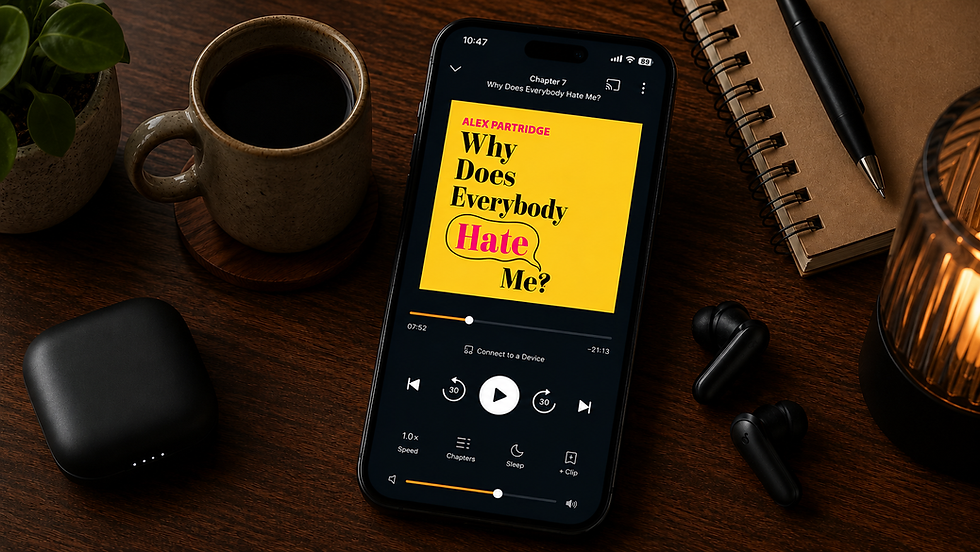
The audiobook Why Does Everybody Hate Me? by Alex Partridge is probably the first book dedicated entirely to Rejection Sensitivity Dysphoria (RSD) in people with ADHD. In this review, I look at the book's content, the audiobook performance, its practical advice, and the places where the author repeats himself more than necessary.
There are plenty of books that try to explain every aspect of ADHD. Why Does Everybody Hate Me? takes the opposite approach: it focuses on a single topic and explores it from every possible angle.
That topic is Rejection Sensitivity Dysphoria (RSD)—an intense emotional reaction to real or perceived rejection or criticism. Although many people with ADHD describe RSD as one of the most painful parts of living with the condition, surprisingly few books are devoted entirely to it. That's exactly why Alex Partridge's latest release caught my attention as soon as it was announced.
If the author's name sounds familiar, you've probably come across his podcast ADHD Chatter or his first book, Now It All Makes Sense. That one was primarily a personal story about discovering his ADHD diagnosis. Why Does Everybody Hate Me? is different. It's less autobiographical but considerably more focused, allowing it to explore one subject in far greater depth.
Alex Partridge isn't a psychiatrist or psychologist. He's someone who lives with ADHD, interviews experts for a living, and has spoken with hundreds of neurodivergent people whose stories he weaves throughout the book. That combination gives the book a unique voice. It isn't a textbook, but it isn't a memoir either. It sits comfortably somewhere between popular science, personal storytelling, and a practical self-help guide.
What You'll Find Inside
Partridge explains what RSD actually is and why something as small as an unanswered email, a neutral facial expression, or a brief comment can spiral into an emotional catastrophe.
He explores how RSD develops, how it affects romantic relationships, friendships, and communication, and why so many people with ADHD fall into cycles of perfectionism, people-pleasing, or impulsively quitting jobs.
A significant portion of the book focuses on the workplace. Why criticism from a manager can feel devastating. Why we assume our colleagues secretly dislike us. Why a single piece of feedback can derail us for days.
The book also offers practical strategies for managing RSD, including:
Recognising when you're experiencing RSD rather than objective reality.
Physically changing your environment to give your nervous system time to calm down.
Separating facts from catastrophic assumptions.
Building genuine self-esteem instead of constantly seeking validation from others.
One suggestion I particularly liked concerns communication in relationships. Instead of saying, "We need to talk," Partridge recommends adding reassuring context—for example, "Nothing's wrong, I just want to discuss our grocery shopping." For someone without RSD, that might seem like an unnecessary detail. For someone with RSD, it can be the difference between a peaceful evening and several hours of anxiety.
What Works Best
The greatest strength of the book is the abundance of real-life stories.
Rather than relying solely on his own experience, Partridge shares the voices of many other people with ADHD. It quickly becomes clear that he's far from the only person who's convinced themselves everyone hates them simply because someone didn't reply to an email.
That blend of lived experience and accessible explanations makes the book genuinely validating. Many readers will recognise themselves in its pages.
Since I also create ADHD-related content, I found myself taking mental notes throughout the audiobook. RSD is one of the most important ADHD topics in my eyes, yet it still receives far less attention than it deserves.
What Didn't Work for Me
Ironically, my biggest criticism stems from the author's determination to reinforce one central idea.
Throughout the book, he repeatedly mentions the claim that children with ADHD receive 20,000 more negative comments than their neurotypical peers by the age of twelve. The statistic comes up again and again.
The problem is that this figure isn't supported by strong scientific evidence. At best, it's an informed estimate, yet it's often repeated within the ADHD community as if it were an established fact.
The same goes for Partridge's recurring mantra: "You've always been enough."
It's a lovely sentiment. But after hearing it for the tenth time, it starts feeling more like a motivational catchphrase than a powerful insight.
Overall, I think the book would have benefited from a bit more editing. It already has plenty of valuable ideas without repeating the same ones so often.

The Audiobook Experience
Alex Partridge narrates the audiobook himself, and it's obvious that speaking into a microphone is his natural habitat.
His delivery feels relaxed and conversational. At times, it feels less like listening to an audiobook and more like tuning into another episode of ADHD Chatter.
There are moments when you can tell he's reading from a script rather than speaking spontaneously, but that never becomes distracting. Overall, it's an enjoyable performance, and I'd definitely recommend the audiobook over simply reading the text.
Final Verdict
Why Does Everybody Hate Me? isn't my favourite Alex Partridge book—that title still belongs to Now It All Makes Sense. Not because this one is worse written, but because the earlier book covers a broader range of ADHD experiences and its personal narrative resonated with me more deeply.
That said, I'm genuinely glad this book exists.
RSD affects our work, relationships, confidence, and everyday decisions, yet there are remarkably few books dedicated solely to understanding it. If you've ever spent hours replaying a single critical comment in your head or wondered why your ADHD brain reacts so intensely to rejection, you'll probably recognise yourself in these pages.
Just be prepared to hear some of the same points more often than necessary.
Glitches & Glory Verdict: A thoughtful deep dive into one of ADHD's toughest bosses. It could have been tighter and less repetitive, but if you're looking for a book specifically about RSD, this is currently one of the strongest options available.
⭐⭐⭐⭐☆ (4/5)
Topics: ADHD, Rejection Sensitivity Dysphoria (RSD), rejection sensitivity, Alex Partridge, Why Does Everybody Hate Me?, audiobook review, ADHD books, ADHD Chatter, emotional regulation, perfectionism, people-pleasing, neurodivergence
As an Amazon Associate I earn from qualifying purchases.
Jako účastník programu Amazon Associates vydělávám na způsobilých nákupech.


Comments