The Secret of Secrets: Dan Brown vs. Someone Who Actually Lived in Prague

Updated: May 12
How does The Secret of Secrets seem to someone who actually spent a few years living in Prague?
There are basically two kinds of readers who are going to enjoy Dan Brown’s latest book.
The first group is here for the pacing, the codes, the secret societies, and Robert Langdon sprinting across European capitals like a man who has never experienced road construction, morning trams, or the stairs up Petřín Lookout Tower.
And then there’s the second group: people who have actually lived in those cities. For them, The Secret of Secrets becomes a slightly different experience.
Not because Brown completely failed Prague. Honestly, quite the opposite. You can tell he did the guided tours, read up on the history, and spent serious time researching. Many locations are real, some descriptions are surprisingly accurate, and every now and then he pulls out details most tourists would never even notice.
But then you hit the moment where Langdon casually runs from Old Town to Strahov at six in the morning, crosses Charles Bridge covered in perfectly untouched February snow, and you suddenly think:
“Ah. This was written by someone whose main experience with Prague came from Google Maps.”
And that’s exactly what this article is about. This is not a review of the plot, nor a spoiler-heavy breakdown of the mystery. It’s more of a side-by-side comparison between Brown’s version of Prague and the Prague known by people who actually lived there for years.
Langdon’s Morning Cardio
One of the first scenes in the book shows Robert Langdon leaving the Four Seasons Hotel early in the morning to go swimming at the Strahov pool. Technically speaking, the distance really is just a little over three kilometers (about two miles).
Practically speaking, though… that’s a very different story.
Because Strahov is not “just outside the city center.” Strahov is a hill. A very noticeable one.
If Langdon really ran there from the Four Seasons, this wouldn’t be some gentle riverside jog. It would be a pretty serious uphill climb involving several extremely recognizable Prague landmarks along the way.
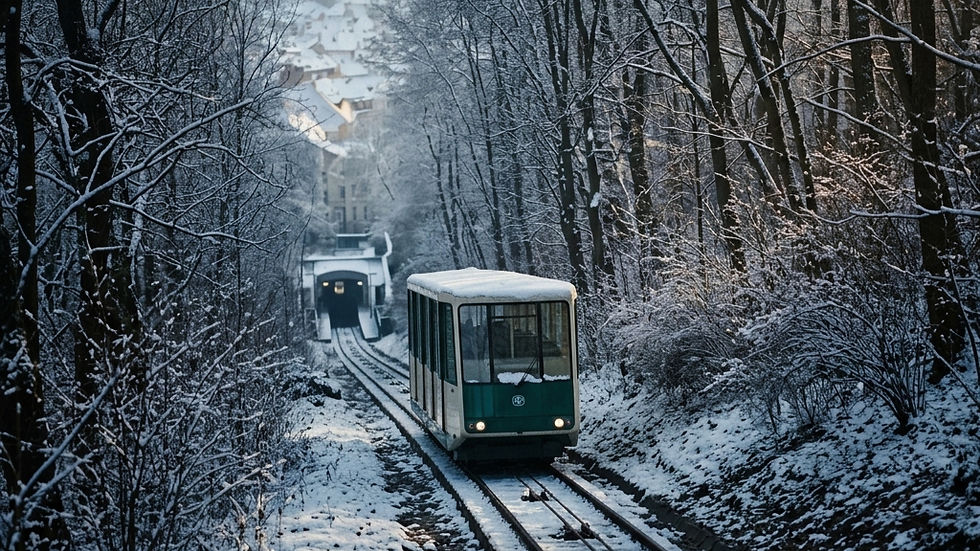
He would either pass the lower station of the Petřín funicular, run through Petřín Gardens where the funicular crosses the park, or go past the Memorial to the Victims of Communism.
And yet Brown only mentions these places much later, almost as if Langdon is seeing them for the first time. Which feels slightly odd, because if you move through that part of Prague on foot, avoiding those landmarks is basically impossible.
To be fair, though, Brown did get one detail completely right: The Strahov swimming pool really is 25 meters long. So clearly, the research happened. Just maybe not in running shoes.
Charles Bridge and the Suspiciously Untouched Snow
Dan Brown presents his own version of Prague in February. So naturally, Langdon runs to Strahov early in the morning…
…across Charles Bridge covered in a flawless layer of untouched snow.
Atmospherically, it’s gorgeous. Foggy winter dawn, a historic bridge, complete silence, soft white snow without a single footprint. The problem is that to anyone who has actually spent time in Prague, this feels wildly unrealistic.
Charles Bridge is not empty at six in the morning. Sure, it’s quieter than during the day, but it’s still one of the busiest pedestrian routes in the entire city center. You’ll find tourists stumbling home from bars, runners, dog walkers, photographers waiting for sunrise, and locals simply heading to work.
The idea that fresh snow would remain perfectly smooth and untouched there feels about as realistic as instantly getting onto the correct Prague tram and finding a seat.
Technically possible?
Sure.
Likely?
Not really.

The Four Seasons Jump
During their stay in Prague, Robert Langdon and Katherine Solomon are apparently living in the Royal Suite of the Four Seasons Hotel, which the book describes as sitting practically above the surface of the Vltava River itself. From the suite’s bay window, Langdon supposedly has a direct view of both the river and Prague Castle—and in one particularly dramatic moment, he panics and jumps straight into the water below.
And this is the point where Brown’s version of Prague starts drifting into full-on parkour fantasy.
Yes, the Four Seasons really is located very close to the river, and yes, the higher floors genuinely do offer beautiful views of Prague Castle. The problem is that there is still an embankment between the building and the Vltava. The hotel is not built directly above the water.
So if Langdon actually wanted to jump from the window into the river, he would first need to clear a gap of at least six metres—or roughly 20 feet.
In other words, instead of an elegant thriller-style escape into the Vltava, the scene would most likely end with an extremely intimate encounter with Prague pavement.
Charles University vs. Vladislav Hall
One of the moments that immediately stood out to me while reading was the idea that Charles University—my alma mater—would host a lecture inside Vladislav Hall at Prague Castle. On paper, it sounds magnificent. Cinematic. Exactly the kind of setting Dan Brown loves to turn into several pages of dramatic exposition. In reality, though, it’s much less mysterious and much more bureaucratic.
Vladislav Hall is primarily used for major state ceremonies, official receptions, and events like presidential inaugurations. It is not the kind of venue that regularly hosts university lectures.
Charles University already has its own ceremonial spaces, most famously the Carolinum, and the vast majority of academic talks and public lectures happen directly at individual faculties.
A good example is the Faculty of Arts, where larger public events are often held in Lecture Hall 131, which seats around four hundred people. It may not sound as thrilling as “a lecture at Prague Castle,” but it is significantly closer to how academic life in Prague actually works.
Costumes Everywhere
Dan Brown repeatedly describes central Prague as a place where people casually walk around dressed as historical or mythical characters without anyone finding it remotely unusual. In his version of the city, Prague occasionally feels like a permanent carnival populated by alchemists, monks, and various mysterious archetypes wandering through medieval streets.
Reality is… considerably less dramatic.
If you run into someone dressed like a medieval character in central Prague, it usually falls into one of three categories: They’re trying to lure tourists into a themed bar, they’re part of a foreign bachelor party, or it’s Czech graduation season. And even that has limits, because graduation street celebrations usually happen in May, not February.
You could theoretically argue for pre-Easter carnival traditions (Masopust in Czech), but those are much stronger in smaller towns and villages, especially in the eastern parts of the country. Prague’s city center operates on a completely different rhythm. The result is a version of Prague that blends reality, tourist marketing, and a light fantasy filter—which honestly fits Brown’s style surprisingly well.
Hemingway Bar & Video Game Geography
To be fair, not everything is wildly inaccurate. Some of Brown’s smaller details are actually impressively specific. The book references real places like AnonymouS Bar, Hemingway Bar, and the Týn Literary Café—and yes, all of them genuinely exist in Prague.
What feels slightly off is the geography. The way the novel presents these places makes them sound like neighboring locations you can casually move between in under a minute, when in reality they’re scattered across the city center.
Brown’s Prague sometimes works like a video game map where every important location exists only a few minutes apart so the pacing never slows down.
From a storytelling perspective, it works brilliantly. The constant movement keeps the tension alive. From a practical perspective, though, it feels very different if you’ve ever tried finding a specific café in Prague’s crowded Old Town on a Saturday afternoon.
Codex Gigas in Prague
In the book, Dan Brown claims that the Codex Gigas—the famous “Devil’s Bible”—regularly returns to Prague every ten years and is exhibited inside the historic library halls of the Klementinum.
The reality is… not quite that cinematic.
The Codex Gigas was loaned to Prague in 2007 as a genuinely extraordinary event. A special secure vault with carefully controlled climate conditions had to be created specifically so the manuscript could even be displayed safely to the public. And importantly: this exhibition space was located in a completely different part of the building than the world-famous photogenic Baroque library hall tourists usually associate with the Klementinum.
One detail Brown does get right is the timed-entry system. Tickets were indeed tied to specific time slots because a manuscript this valuable simply cannot handle unlimited crowds passing through the room all day.
But later exhibitions displayed only a replica, not the original manuscript itself. So the idea of the Codex Gigas casually returning to Prague on a regular “tour” belongs more to the realm of thriller mythology than actual museum logistics. Future loans are absolutely not guaranteed or automatic.

Klementinum and the Morning Tourist Myth
It gets even more surreal in the section where Brown describes the Klementinum as a place that opens at 7 a.m., with American tourists supposedly being shuttled in by buses straight from the airport. For free. At that point, reality and the book’s version of Prague start drifting in noticeably different directions.
The Klementinum actually opens at 9 a.m., and its operation is largely tied to the National Library, which is primarily responsible for managing historical and academic spaces—not running tourism logistics or airport transfers. The idea that a cultural institution would organize morning shuttle services for visitors is, in practice, completely unrealistic.
Prague already has a well-functioning public transport system, and tourists typically reach the city center the normal way: public transit or taxis.
The image of a cultural institution casually transporting American groups to medieval manuscripts every morning does sound like a charming parallel universe with an unlimited budget, but it has very little in common with how Czech cultural institutions actually function.
The Tram Driver with Hawk Eyes
One of the most “cinematic” scenes in the book takes place between Petřín and Újezd, where Langdon runs out of the lower Petřín funicular station, jumps onto a tram heading toward the city center, and tries to reach the Klementinum as fast as possible. The tram number is correct. He only stays on for a single stop.
At the same time, a manhunt is announced, which the tram driver overhears—so when Langdon gets off, she reports where she saw him and which direction he went.
Except… that’s where Prague physics quietly enters the chat.
Langdon would have to get off near the National Theatre and then head back toward the embankment, cross the street, and disappear behind the building with the famous Café Slavia. From the driver’s position, he would already be behind the tram, with no realistic way to track his movement through the crowd, let alone see which street he turns into.
And that’s before factoring in the dense flow of pedestrians, because—just to state the obvious—this is one of the busiest parts of Prague.
The result is a scene that works perfectly as a tight thriller cut, but in real-life Prague traffic it would dissolve into the usual morning chaos: people exiting, disappearing between cars, and trams moving on without any cinematic tracking system for individual passengers.
The Memorial at Újezd
Dan Brown actually captures the visual impression of the Memorial to the Victims of Communism at Újezd quite accurately. In the book, Langdon calls it one of the most unsettling and powerful works of art in Europe, describing a series of figures that gradually break down, lose parts of their bodies, and turn into increasingly incomplete forms—which does match the immediate visual experience on the staircase.
Langdon’s interpretation goes like this:
“The most disturbing part was that it was always the same person... just in different stages of decay.”
In reality, though, the symbolism works differently. The monument is not about a horror-like physical decomposition of a single individual, as Brown’s description suggests, but about the gradual stripping away of human wholeness under a totalitarian regime that removes identity, freedom, and dignity—while the people themselves still remain standing, even if increasingly reduced.
At the top of the memorial there are clearly seven figures. The first is complete, and each following figure becomes progressively more damaged, until the final one is reduced to a fragment—just a foot with part of the instep—still unmistakably human in its trace.
So the monument is not about destruction for its own sake, but about persistence and resilience in the face of systematic erasure.
Interestingly, Langdon only describes the memorial at the very end of the book, even though he must have passed it at least once, probably more. But then again—who has time for art when they’re being chased or fitting in a morning swimming ritual?
The Skating Nun of the Alchymist Hotel
At the end of the book, Brown mentions the legend of a skating nun connected to the Alchymist Hotel. It’s very likely not based on a single authentic tradition, but rather a blend of several different Prague ghost stories. The real question is whether this is authorial invention or something someone in Prague confidently told him as fact.
The first part of the legend is tied to the house where the hotel now stands. But the original story is far less supernatural than Brown’s version suggests—it’s more of a real-estate scam than a ghost story. According to the tale, a potential buyer spread rumors that a walled-in nun was haunting the building in order to lower the price and pressure the owner into selling.
During later reconstruction, people kept asking whether the remains had been found. To reinforce the myth, the new owner reportedly placed calf bones into the foundations as “evidence.” However, an official inspection later revealed they were not human remains at all, and the entire scheme ended in public embarrassment rather than confirmation of a haunting.
The second source of inspiration likely comes from the House At the Black Boot in Řetězová Street, where a 17th-century house sign still survives. Its shape vaguely resembles a roller skate, which naturally led to all kinds of folk reinterpretations that had very little to do with historical reality.
The third layer is the broader Prague folklore of “skating ghosts” and ice-walking nuns, part of a wider collection of winter ghost stories often associated with the frozen Vltava near the Convent of St. Agnes in Old Town—told more as seasonal folklore than as recorded events.
And from a blogging perspective: this tiny throwaway mention—which ultimately leads to a scene of a girl taking selfies on the ice—somehow required the deepest research dive of all. But honestly… a skating nun in the middle of Malá Strana? Really?

The Doors with Seven Locks
The final act of the book takes us to one of the most sacred and heavily guarded places in the Czech Republic—the St. Wenceslas Chapel inside St. Vitus Cathedral—where Robert Langdon and Katherine Solomon finally stand in front of the legendary doors with seven locks.
And this is one of those rare moments where Dan Brown actually stays very close to reality without needing to dramatize it into submission. Behind those iron doors in the Crown Chamber are the Czech Crown Jewels, including the St. Wenceslas Crown. The security system is real and famously complex: seven keys, each held by a different high-ranking state or church official.
To open the chamber, all seven must be physically present at the same time. No exceptions, no shortcuts. It turns the unlocking into a highly formal state ritual that only happens on exceptional occasions—like presidential elections or major national anniversaries.
A Name That Doesn’t Quite Land
One detail that quietly throws Czech readers off balance is the character of the scientist Brigita Gessner. Her name doesn’t feel particularly Czech—it leans more toward German linguistic roots, and in a Prague context it could suggest foreign heritage, or possibly deeper Central European or even Jewish background.
The issue isn’t that the name is impossible. It’s that it feels slightly unanchored. And unlike other characters, where Brown often carefully explains background details—like the American ambassador Heide Nagel, whose German roots are explicitly addressed and woven into her character—Brigita Gessner is left floating without context.
For Czech readers, it’s a small but noticeable glitch. Not wrong, just slightly “off.” Like a name pulled from a mental database labeled Central Europe: plausible enough without fully checking how it sounds in actual Czech reality.
She could absolutely exist. She would just more likely be Petra, Jana, or maybe Tereza Gessnerová.
That’s It. I’m Done. Seriously!
There’s still plenty that could be unpacked—Czech police procedures, Brigita’s lab, Langdon handling a manual transmission car...
But I tried to focus on the Prague details that stood out the most, whether in terms of accuracy or pure creative liberties. And honestly, I’m not here to argue that readers pick up Dan Brown for geographic precision. They don’t. They’re here for Langdon’s symbolic interpretations, fast-paced puzzles, and absurdly over-the-top conspiracies—because that’s what The Secret of Secrets is built on.
And the plot is… well. Let’s just say it’s very, very unhinged. Moving away from Langdon’s usual historical playground into neuroscience and modern tech means we get fewer of his classic deep dives. And Brown still leans on his favorite trick: the protagonist discovers something huge, but the reader is conveniently not allowed to know what it is until later. At this point in the series, it feels like a well-worn track.
Even the title itself comes off a little self-important—and yes, it does get explained in the book.
But it’s Dan Brown. And it’s a book set in Prague. My Prague. The city I walked through on foot after the 2002 floods, when transport barely worked and the city felt half submerged and half rebuilt.
And maybe that’s exactly why the inaccuracies didn’t really bother me. Beneath all the thriller exaggeration, there is still a version of Prague that Brown is trying to capture—magical, mysterious, slightly unreal.
It’s just that Prague already does that on its own terms. Just usually in a very different way than American thriller writers imagine.

Robert Langdon is back in the long-awaited new race-against-time thriller from the global bestselling author of The Da Vinci Code and Angels and Demons.
By ordering on Amazon using my affiliate link, you can support this blog.
As an Amazon Associate I earn from qualifying purchases.
Topics: Dan Brown, Prague, Thriller, Literature, Czech Culture, Robert Langdon


Comments